

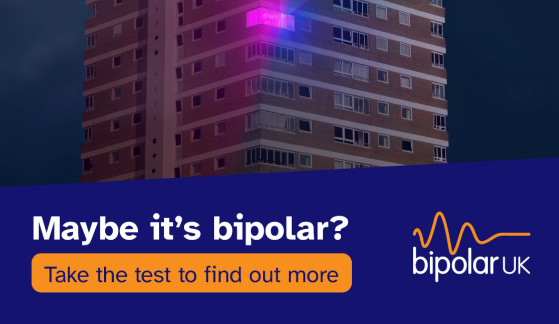
In the run up to Fresher’s Week, national mental health charity, Bipolar UK, is launching their student-focused version of the ‘Maybe it’s bipolar?’ campaign to reach one of the most vulnerable groups of people living with undiagnosed bipolar -secondary and higher education students.
1 in 50 people in the UK live with bipolar, with more than half of those saying they have exhibited symptoms before the age of 21 that have significantly impacted their higher education options and experiences.
While university life is meant to be full of fun and opportunity, as well as a step towards a future career and stability, it also comes with known triggers for anyone living with bipolar, such as leaving home, lack of sleep, exam stress, lack of routine, alcohol and drug misuse and financial independence.
In addition, the average age for people to get a diagnosis of bipolar has increased from 26 to 34 over the last 30 years, resulting in many people going into higher education experiencing symptoms of bipolar but either not knowing what they are or already being misdiagnosed and receiving incorrect treatment.
The charity is now urging students who are exhibiting certain symptoms, such as difficulty sleeping, overspending, irritability and the highly stigmatised hypersexual behaviour to take the bipolar test to identify if a bipolar diagnosis and appropriate support is worth exploring.
Speaking about the campaign, Deputy CEO of Bipolar UK, Rosie Phillips, said: “An estimated 56% of people with bipolar do not have a diagnosis, and the average time it takes to get one (after reporting symptoms) is 9.5 years.
“While it might feel scary to consider that you have bipolar, the reality is that with the right support, medication and lifestyle changes, you can live a great life and pursue the career path and opportunities you’d like to.
“We want to use this opportunity to educate students and their peers about the symptoms of bipolar and signpost them towards the relevant resources and, ultimately, a diagnosis.”
People in higher education account for 6.5% of the UK population meaning over 90,000 students might be living with bipolar and prompting Bipolar UK to engage with universities and attend Fresher’s Fairs to reach more students, educating them earlier about the symptoms of the condition and reducing the diagnosis delay. Their message is clear – the earlier people access support, the brighter their future can be.
Someone with bipolar can have long or short periods of stability but can then go ‘low’ (into depression) or ‘high’ (experiencing hypomania and/or mania and psychosis).
Bipolar mood swings are more extreme than most people’s everyday experiences of feeling a bit down or happy.
Through the campaign, the charity is raising awareness of common symptoms of bipolar, including hypomania which is when people experience periods of low mood followed by periods of overspending, reduced need for sleep, risk taking and more. These can become particularly prevalent when someone is under stress or out of routine, such as when they start university.
Without the proper treatment and support, the implications are severe:
- Suicide attempt rates are over 50 times higher among young people with bipolar than among those without bipolar.
- Of the 2571 people living with bipolar surveyed to ask about ‘bipolar and diagnosis’, 43% told the charity they had left their job and/or studies due to a delay in diagnosis, highlighting why earlier intervention is essential.
- A survey of 865 people with bipolar in 2022 found that nearly three-quarters of respondents had been to college or university, but a notable one-third of people had left university early.
Just a few of the quotes the charity has received from former students show the impact undiagnosed bipolar can have on young people at university and how a diagnosis and accessing the right care can make all the difference:
Caitlin aged 23 said: “I had clear symptoms of depression from quite a young age, I first noticed what felt like an inability to feel as happy as everyone else at the age of 10 which followed me into my teenage years.
“Far less easy to describe were the periodic episodes of hypomania I experienced. It was totally bewildering, I had no idea what was going on with me – the boundless energy, the paranoia were so unlike me.
“When I was around 15 years old I went to my GP about problems sleeping and depression but I was told that I’d probably get over it and it wasn’t taken any further. The symptoms didn’t go away, and in fact got a lot worse.
“Following a break-up in my second year of uni, I was flung headfirst into depression and put on anti-depressants which then triggered a destructive manic episode. I remember sobbing down the phone that my feelings were so overwhelming and the mood swings I had been experiencing were brutal. It was only then that a GP took me seriously and I first heard the words ‘this sounds like bipolar’.
“I was referred to the Adult Mental Health Team and diagnosed officially with Bipolar 1 about two months later at the age of 19.
“The manic episode I had during university ruined so much for me. I ruined relationships, my reputation, and had to step down from a disabilities representative role that I had loved.
“The depressive side of bipolar made it really hard to give my degree my all. I went to an elite university and the pressure was immense. I completely cracked under it. I’d never felt so unsure of my abilities and my future.
“Everything changed after I was diagnosed and medicated. I finally understood myself, and more importantly, the episodes stopped completely. I still had wobbles from time-to-time, but nothing like the episodes I was battling alone for so long. People also became more sympathetic after I was able to explain why I’d acted the way I did and I felt like I could apologise to them wholeheartedly with the knowledge that I did these harmful things because I had an untreated mental health condition that I was now committed to controlling the effects of, not because I was an irredeemably cruel person.”
Niamh aged 27 said: “I was dismissed by my GP as being ‘too young to have bipolar’ when I went to see them about my mood, aged 14.
“It took me until I was 19 and studying abroad in California where I became very manic and unwell. I was sent to a psychiatric facility after going to the medical centre on campus at California State University Long Beach, where I was diagnosed with bipolar and treated. Upon returning home a few months later, an NHS psychiatrist confirmed my diagnosis.
“University was difficult because I knew I had bipolar and I was manic and struggling and self-harming but I denied there was anything seriously wrong. I still did alright at university and thankfully made some wonderful friends, but it was a challenge having bipolar because I felt different and hated myself for my symptoms.
“In my third year I attempted to take my life. This attempt came from mania and not taking my medication. The university (University of Leicester) were very supportive afterwards which was good alongside my friends and family.
“Universities hopefully hold a much better space for mental health now, there just needs to be less stigma. Bipolar is difficult but it’s made me into someone very strong and positive now and I think children and teens need to be listened to and understood more.”
The campaign forms the start of a pilot scheme by the charity launching next month in Brighton which includes an awareness walk around the town with ambassadors and allies alongside an out of home campaign to raise awareness of symptoms and engage students through action and education. This will then be rolled out in other university towns and cities across the UK.
People who recognise any of the symptoms are encouraged to take a simple online test to explore whether their experiences could be linked to bipolar. To find out more, visit Take the bipolar test | Bipolar UK
Featured photo credit: Maybe its bipolar university campaign