

Sands charity leading campaign to save babies’ lives
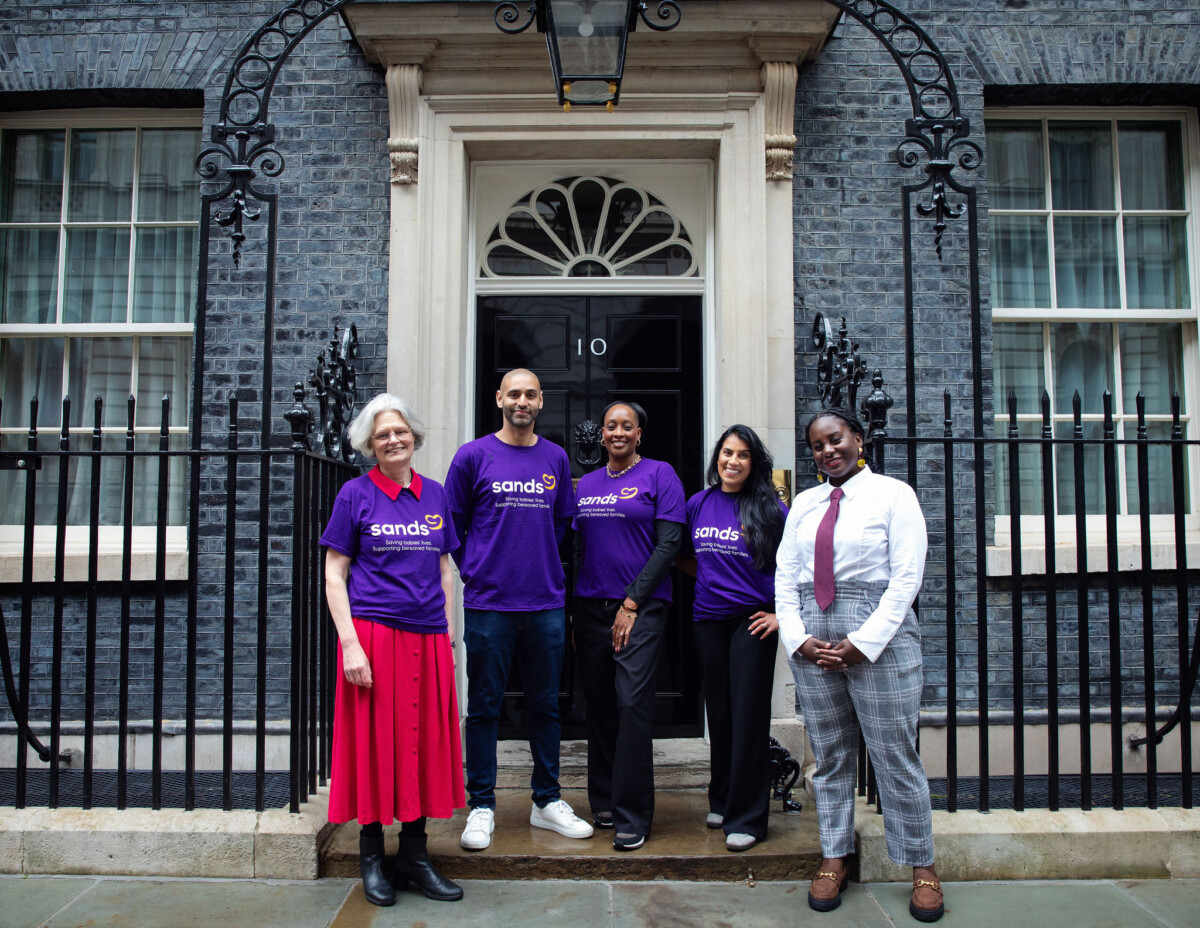
A group of bereaved parents from Black, South Asian and mixed ethnic backgrounds handed in an Open Letter to the Prime Minister today (11 May) calling for urgent action to end inequalities by ethnicity in baby loss.
In the Open Letter, they shared their experiences of having their concerns ignored and of experiencing differential treatment because of their ethnicity. More than 3,300 people have signed the Open Letter calling for action.
The hand in at Number 10 Downing Street was the culmination of the End Inequalities in Baby Loss campaign led by the pregnancy and baby loss charity Sands.
The campaign is calling for new targets to eliminate inequalities in baby loss and for action across the Government, NHS and professional bodies to make care safer and more equitable – to save Black and Asian babies’ lives.
The current national ambitions to reduce baby deaths in England expired in 2025 and it seems likely that these have not been met. New targets for every UK nation must renew and build on these ambitions to explicitly measure rates of baby deaths for different demographic groups.1
Each UK government must commit to setting these targets and ensuring that systems are in place to measure progress on an annual basis, and act if they are not on track.
New analysis from Sands shows that if the stillbirth and neonatal death rates for Black and Asian babies in 2019-2023 had been the same as those for white babies, 1,616 lives could have been saved.2
The End Inequality in Baby Loss campaign was founded as a result of the Sands Listening Project, which spoke directly with Black and Asian bereaved parents about the maternity and neonatal care they received. This project shone a light on the reality of systemic racism experienced by many Black, Asian and mixed ethnicity families when navigating NHS services.3
Sands Chief Executive Clea Harmer said: “The parents I walked alongside to Downing Street today carried with them not only the Open Letter to raise these inequalities in baby loss with the Prime Minister. They also carried the love for their babies, and the hope and determination that change is possible to save future lives.
“Our End Inequalities in Baby Loss campaign set out to convince politicians and other decision makers that together we can build a more equitable system that gives all families the care they deserve. I hope that today is the moment when these parents’ voices are heard and the Government takes action.
“These are not simply numbers, these are babies who are loved and will never be forgotten by their parents and families. They matter to us too. We are here for all those who need support today and at any time, for as long as they need this.”
Bereaved parents calling for change
Among the bereaved parents who handed in the Open Letter to Number 10 today were Bhavna Bhargava, Raj Chagger and Rachel Burrell. Together with all the authors and signatories of the Open Letter, they are asking the UK Government to take urgent action to end inequalities in baby loss.
Bhavna Bhargava is one of the authors of the Open Letter. In May 2019, her son Joshan passed away in his father’s arms, shortly after he was born, after they were told by doctors that he would not make a recovery, following a delayed emergency c-section.
Bhavna said: ‘When we were asked to be involved in this campaign, we were honoured to do so. And now this has come to fruition it feels momentous, especially as May is a poignant month for us as that’s when Joshan was born.
“I will be taking Joshan’s knitted blue beanie to Downing Street, along with a photo of him in my arms wearing this. This is the only physical connection I have to him. It was the first and last thing he wore before he left the hospital to be taken to Great Ormond Street for his post mortem.
“To be honest it’s the first time I have actually taken it out of his memory box. Just seeing and feeling the hat takes me back to May 2019 along with all the sadness. He should have been here looking forward to celebrating his seventh birthday had the hospital listened.
“Baroness Amos’ ongoing maternity and neonatal investigation and her interim report in February, which found pervasive, deep-rooted issues, including inadequate care and neglect, are a reminder of the systemic failures I was faced with. That’s why this Sands campaign is so important to raise awareness and to prevent future baby deaths.”
Raj Chagger is a bereaved father, advocate, and community leader who has been supporting Sands since the loss of his son, Riaan, in November 2020. He became a Sands Trustee in 2025.
Raj said: “This moment is deeply personal for me. I’m standing here not just as a dad who lost his son, Riaan, but as part of a community of families whose babies should still be here. Bringing this letter to Downing Street is about making sure our voices are heard, that our babies mattered, and that their lives must lead to change.
“For me, this moment is about turning grief into action. It’s about honouring Riaan’s life by standing up for other babies and families, so that fewer parents have to experience this heartbreak, especially in communities where the risks are still so unfairly high.
“This campaign matters because inequality in baby loss is not inevitable, it’s preventable. We’ve heard too many stories of families not being listened to, not being treated with dignity, and not receiving the care they deserved.
“No parent’s ethnicity should determine their baby’s chance of survival, yet we know that it still does. That is something we cannot accept. This campaign is about accountability, but also about hope. It’s about real, life-saving action. Making care safer, more compassionate, and truly equal, so that every baby has the same chance, and every parent is listened to, respected, and cared for.”
Rachel Burrell is a Sands volunteer befriender and campaigner. She was supported by Sands following the death of her daughter Rhema, who was stillborn in 2012. She is also a co-founder of the Ebony Bonds baby loss support group.
Rachel said: “As someone deeply connected to this campaign through my work as a Sands volunteer, this moment is both powerful and profoundly emotional. It represents years of advocacy, lived experience and the collective voices of bereaved families, particularly Black parents, finally being recognised at a level where meaningful change feels within reach.
“This campaign is vital because it shines a necessary light on the stark and unacceptable disparities that exist in baby loss outcomes. For too long, Black families have faced a higher risk of losing their babies, alongside inequitable care experiences that compound trauma and grief.
“Seeing the issue of inequality in baby loss gain national attention, including its inclusion in Baroness Amos’ National maternity and neonatal investigation, marks a significant milestone. It validates the voices of bereaved families and the tireless efforts of grassroots organisations who have been advocating for change long before it entered mainstream conversation.
“This journey has been about persistence, partnership, and pushing for better. While this moment is important, it is not the end, this letter hand in is a critical step forward. We remain committed to ensuring that this momentum leads to tangible improvements in care, outcomes and support for all bereaved families.”
The impact of inequality on baby loss
In the UK, there are persistent inequalities in baby loss by ethnicity. These are particularly striking when you compare rates of baby loss for Black and Asian families with those of white families.4
Multiple reports have time and time again highlighted instances of poor care received by Black and Asian parents.5
Sands-funded research has shown that these inequalities have been public knowledge for over 70 years – yet there has been little progress in tackling them.6
Sands is working towards a future where fewer babies die, and politicians take action to save more babies’ lives, reduce inequalities and listen to bereaved parents.
Sands here to support
Sands is here for everyone touched by pregnancy or baby loss. The charity offers bereavement support in many ways, because everyone grieves differently and this can change over time.
Find out more about all the ways the charity offers bereavement support.
- The Sands and Tommy’s Joint Policy Unit has proposed new national ambitions for reducing stillbirth, neonatal death and preterm birth in England. It calls for a target date of 2035, to align these new maternity ambitions within the 10 Year Plan for the NHS in England. This should include specific targets to end inequalities in pregnancy and baby loss. More information: Towards the best: Future maternity safety ambitions to save more babies’ lives – Sands And Tommys Joint Policy Unit
- Analysis based on latest available ONS and MBRRACE-UK data.
- Half of the participants who took part in The Listening Project believed they received worse care or were treated differently by healthcare staff because of their ethnicity. This included alarming instances of direct and indirect racist stereotyping, behaviours, and language. (Source: The Sands Listening Project, 2023)
- Sources: MBRRACE-UK Perinatal Mortality Surveillance, from January to December 2022 and Child and infant mortality in England and Wales: 2024 (ONS, published 11 May 2026)
- Sources: Systemic racism, not broken bodies, Birthrights (2022); The Black Maternity Experiences Survey, Five X More (2022); Invisible: Maternity Experiences of Muslim Women from Racialised Minority Communities, Muslim Women’s Network UK (2022);Black people, racism and human rights, Joint Committee on Human Rights (2020).
Source: Inequalities and stillbirth in the UK: a meta-narrative review, published in the BMJ