

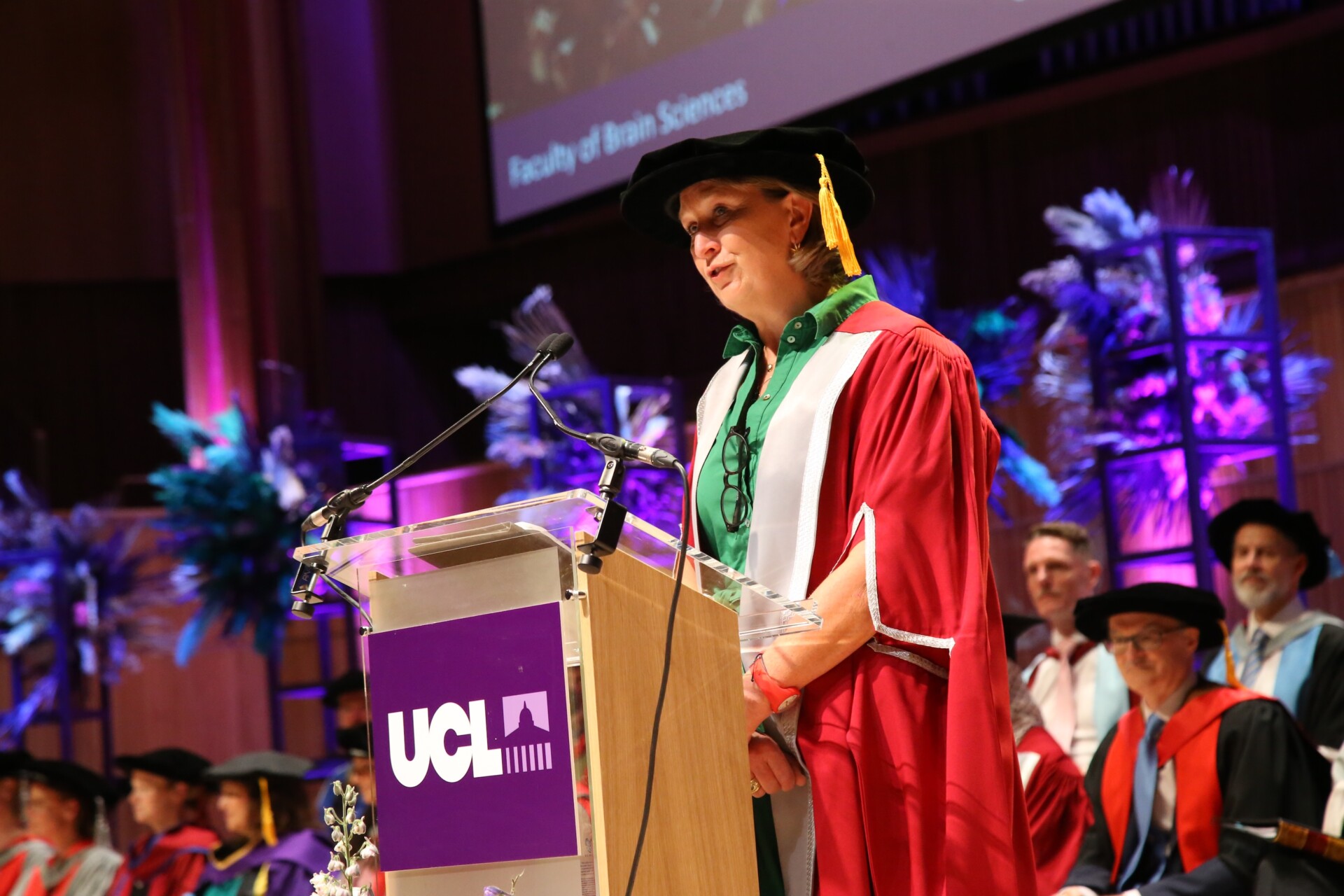
Helen Matthews, CEO of dynamic Parkinson’s medical research charity Cure Parkinson’s, has been awarded an Honorary Fellowship by University College London (UCL), recognising two decades of work that has helped reshape the global Parkinson’s research landscape. The Award was conferred on Monday 6th July at the UCL graduation ceremony at the Royal Festival Hall in London, with Helen delighted to accept this accolade from Vice Provost (Faculties), Professor Jennifer Hudson.
The Honorary Fellowship is one of UCL’s highest accolades, awarded each year by UCL Council to a select group of exceptional individuals who embody the university’s founding values of independent thought, intellectual courage, and a genuine contribution to society. Helen joins a global community of honorary fellows recognised for work that has changed their field, helping to inspire the new generation of the UCL community to excel in their next steps.
For Helen, the recognition reflects Cure Parkinson’s long-standing collaboration with UK and international Parkinson’s researchers, including at UCL, and her influential advocacy across the international charity sector. This work has directly strengthened UCL’s ability to fund vital research and develop treatments that slow the progression of Parkinson’s.
Helen’s connection to Parkinson’s began when she was asked by her long-time friend Tom Isaacs to support the promotion of a 4,500-mile fundraising walk around the coast of Great Britain in 2002.
Tom, who had been diagnosed with Parkinson’s disease at the age of 26, went on to co-found Cure Parkinson’s, and Helen’s marketing expertise made her an obvious choice to transform a fledgling vision held by Tom and three friends living with Parkinson’s into one of the UK’s leading funders of disease modifying Parkinson’s research.
Professor Tony Schapira, UCL Queen Square Institute of Neurology said: “I’m delighted that Helen has been awarded an Honorary Fellowship by UCL. She has worked tirelessly to improve the prospects of those who live with Parkinson’s and to find a cure. She has been a fantastic supporter of all our research on Parkinson’s at UCL Queen Square Institute of Neurology which has been focused on delivering and testing new treatments to slow and prevent this disease. The Fellowship is an excellent recognition of all her contributions over many years.”
After receiving her Honorary Fellowship, Helen said: “I am beyond thrilled to receive this award. It has been an honour and a privilege to work at Cure Parkinson’s since its inception 20 years ago. Throughout that time, my mission has been to drive forward some of the most promising and valuable research into finding a cure for Parkinson’s. There’s still a long way to go, but as a charity, we’re enormously proud of how much we’ve been able to help transform the Parkinson’s clinical research landscape, both here and overseas, as we strive to offer hope and optimism to everyone living with the disease.
This award is a celebration of everything we’ve achieved at the charity so far – and, just as importantly, of the wonderful people I work with, who have poured so much energy and dedication into our mission.”
Helen has been working with the charity since its inception in 2005. In that time, Cure Parkinson’s has committed more than £28 million of funding for Parkinson’s research into over 80 separate research projects and leveraged a further £100 million in funding from partner organisations.
As of March 2024, the charity has awarded funding for research in 38 institutions across 11 countries to 56 individual Principal Investigators.
The honour comes at a pivotal moment for the charity. Cure Parkinson’s research team has just published the most comprehensive analysis ever undertaken of Parkinson’s disease drug clinical trials – a milestone study revealing that, for the first time, research aimed at slowing or stopping the condition has overtaken symptom-management treatments in the global research pipeline. It’s a genuinely significant shift for the more than 10 million people living with Parkinson’s worldwide.[i]
The findings were first unveiled by Dr Simon Stott, Cure Parkinson’s Director of Research, at the 7th World Parkinson’s Congress in Phoenix, Arizona this May, one of the most important international gatherings in the Parkinson’s community.
Looking ahead, Helen added: “We’re looking forward to ensuring Parkinson’s disease-modifying research in the UK flourishes, as we continue our shared commitment to education, innovation and enterprise in the field of Parkinson’s.”
[i] https://www.parkinson.org/understanding-parkinsons/statistics